
How Geofencing is redefining operational efficiency and passenger experience in airports
Advanced indoor geofencing is not just a feature. It is a strategic lever that fundamentally changes airport dynamics. Here's how.
Airports are among the most complex organizations to run today. Passenger volumes are rising, expectations are higher than ever and the gap between a forgettable experience and a genuinely impressive one is increasingly determined not only by physical infrastructure, but also by digital intelligence. Indoor airport geofencing is one of the most powerful technologies driving that gap. But how so?
This article provides you with clearer insights into what geofencing in airports actually means, how an optimised geofencing system functions, why indoor environments require a fundamentally different approach and the benefits of such a powerful capability for your business.
What is geofencing ? And how does a geofencing system work in airports?
Geofencing is the practice of defining virtual boundaries, or "fences", around real-world physical areas. When a visitor carrying a connected device enters, exits or dwells within one of these areas, a pre-configured action can be triggered automatically: for example a push notification, a wayfinding prompt, an operational alert, a loyalty trigger for duty-free promotions.
In airports, geofencing operates entirely indoors and can't rely on GPS signals accuracy because of thick concrete structures, multi-level concourses, underground connections and dense electromagnetic environments.
In fact, all these factors together undermine satellite positioning accuracy. And a system telling a passenger they are "somewhere in Terminal 2" is definitely not useful. On the contrary, an effective geofencing system that knows a passenger is standing 40 metres from Gate B14, with 22 minutes until boarding, can change their entire experience.
To function effectively, geofencing in airports can rely on a combination of technologies for indoor mapping precision to define virtual boundaries, such as Wi-Fi positioning, Bluetooth Low Energy (BLE) beacons and sometimes RFID to triangulate a device's location.
In other words, geofencing is the capability that enables airport teams to know, in real time, where every passenger is inside a specific terminal and to act on that knowledge instantly, automatically and at scale.
Why airports are among the most demanding indoor geofencing environments
Not all indoor venues are equal. Airports come with a unique combination of challenges that other environment can hardly replicate:
- Extreme scale: a major international hub can cover over 500,000 m² across multiple terminals, each with dozens of corridors, hundreds of gates and thousands of simultaneous users looking for key services and facilities' locations.
- High stakes for passengers: a missed gate notification or a wrong turn is not a simple inconvenience; it can turn into a missed flight depending on time constraints.
- Constant change: gate assignments shift, security lanes open and close, flight schedules evolve in real time.
- Mixed zone types: airside, landside, secure, restricted, transit and public areas all coexisting and requiring distinct geofencing system logics.
- Multiple user profiles: frequent airport users, first-time travellers, passengers with reduced mobility (PRM), transit passengers and even airport staff - all navigating through the same indoor space with entirely different needs.
For geofencing to be really effective in airports, it should be designed with all of these factors in mind. At this point, it is not hard to guess why generic location tools built for simpler environments can't meet these requirements.
Three key examples of what indoor airport geofencing makes possible
When geofencing is properly designed and deployed across such a large transportation hub, it unlocks a wide new range of capabilities. Check out what the technology enables across 3 critical areas:
1. Personalised passenger experience and overall user satisfaction
Indoor geofencing transforms the airport digital ecosystem from a static information display into a proactive travel companion. Passengers get the right information at the right moment, based on exactly where they are within the terminal. This, without necessarily having to search for it. Here are some examples:
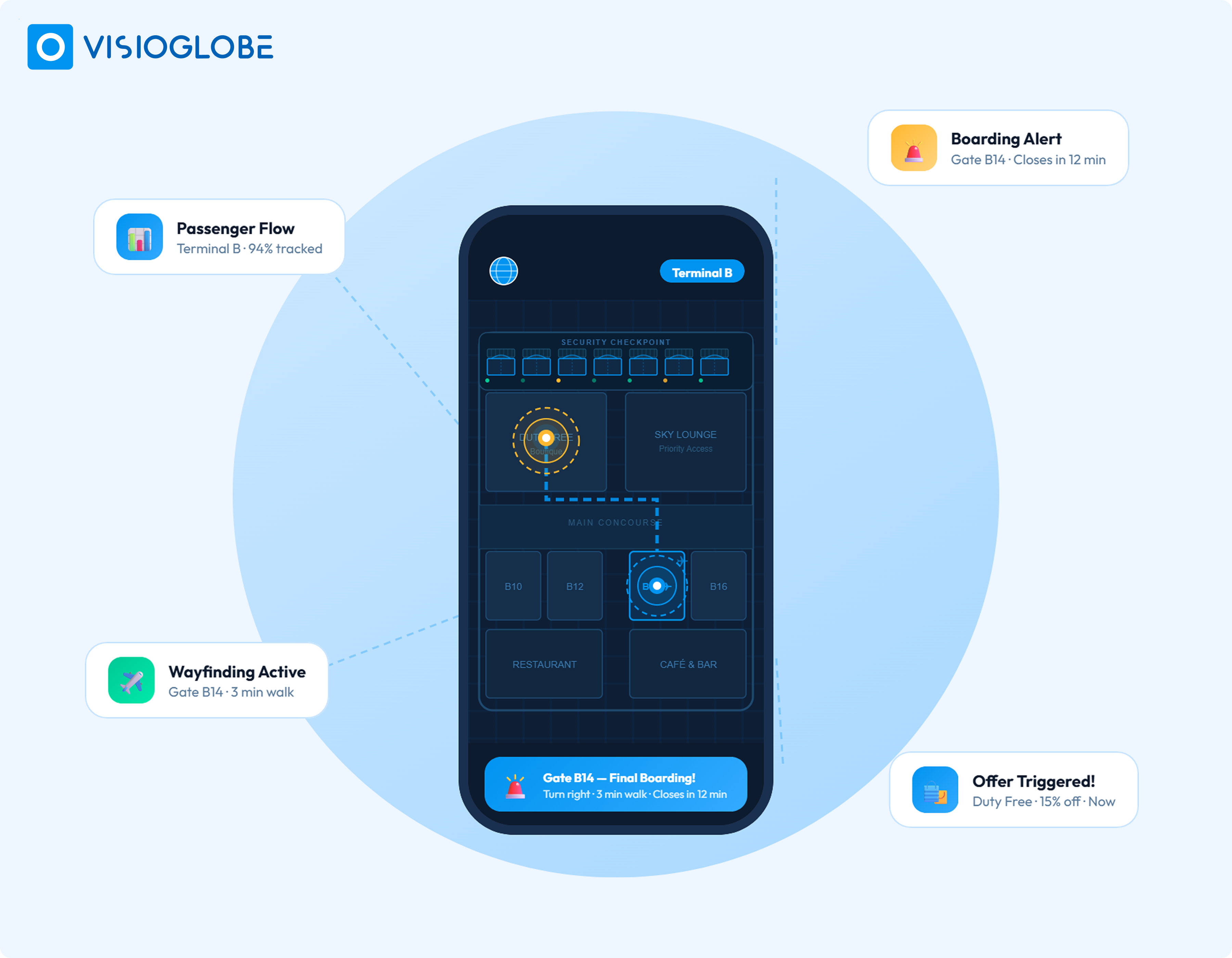
- A passenger entering the duty-free zone with 90 minutes until departure receives a tailored offer from a relevant retailer nearby.
- A traveller approaching their gate with limited time gets a real-time boarding alert and a step-by-step indoor navigation route for the quickest itinerary.
- A connecting passenger stepping off a flight is immediately guided to their next gate, with accurate walking time and live terminal conditions to avoid stressful search and time loss.
- A business traveller entering the premium hall receives a notification about lounge availability and fast-track security access.
- A passenger with reduced mobility entering a specific terminal area is proactively offered assistance services and barrier-free routing to move around safely.
These are not generic messages broadcast to everyone in the airport. They are precise, location-triggered interactions tied to individual context. In other words, geofencing provides the kind of personalization that turns a stressful journey into a smooth, managed one.
2. Operational awareness and increased airport safety
For venue's operators and facility managers, indoor geofencing provides a real-time view on what is happening across every zone of the terminal: a capability that is critical for both day-to-day operations and safety management. Here are some examples:
- Crowd monitoring, for instance across security checkpoints, boarding gates and baggage reclaim areas, with automated alerts when specific zones approach critical density.
- Dwell time analysis to identify where passengers tend to get unexpectedly stuck the most, more easily revealing congestion patterns to solve.
- Staff location awareness to optimize precise services deployment across terminal areas during peak and off-peak periods.
- Incident response support when an area needs to be cleared or managed, so that airport operators know exactly who is in it and can push targeted guidance to users in that zone for a quick way out.
- Real-time flow data feeding into operations dashboards, enabling data-driven and proactive decisions.
Over time, the aggregated data from indoor positioning and geofence events builds an increasingly detailed picture of how the airport actually functions: which routes passengers prefer, where bottlenecks predictably form and how operational changes affect passenger behaviour and satisfaction across the large venue.
3. Commercial Revenue and Retail Performance
Geofencing in airports is also a powerful commercial tool. Location-based engagement at the zone level allows retail and concession teams to reach passengers with relevant offers at the precise moment those offers are most likely to convert. Here are some examples:
- Targeted promotions delivered when passengers dwell near a specific duty-free outlet.
- Dynamic offers tied to remaining departure time, with different messagings for a passenger with 20 minutes versus 90 minutes to spare.
- Loyalty programmes are triggered by physical presence in those specific brand zones.
- Post-visit analytics revealing which retail areas generate the most engagement and which zones are underperforming commercially.
When geofencing-powered promotions are relevant and timely, passengers actually experience them as a service, not an interruption. The result is higher engagement, stronger commercial performance and increased retail environment attractiveness.
The Technical Requirements: why geofencing should be a built-in indoor map system
Deploying indoor airport geofencing at scale is not a simple integration task. The platform must deliver:
- Topology-aware zone logic: geofences that respect floors, walls, security boundaries and the actual physical structure of the building - rather than flat 2D overlays that bleed between levels.
- Real-time event processing: low-latency trigger handling that ensures notifications and alerts reach users while they are still relevant.
- Multi-zone support at scale: the ability to manage hundreds or thousands of concurrent geofences across a large, multi-terminal aviation facility.
- Full system integration: seamless connection to the airport's mobile apps, flight information display systems, CRM, retail platforms, and operations tools.
- Privacy and compliance: transparent handling of passenger location data, fully aligned with applicable aviation and data protection regulations.
The most important architectural principle is this: indoor geofencing should be native to the mapping platform to be fully effective, rather than an added solution on top of it. When the map engine and the geofencing logic share the same data model, zones are floor-aware, topology-correct and aligned with the real structure of the terminal.
Key questions to ask when evaluating an indoor geofencing system for your indoor spaces
Not all platforms are equal. Before committing to an indoor geofencing system, airport digital and operations teams should ensure they can get clear answers to the following:
- What indoor positioning technologies are supported and what real-world accuracy can be demonstrated inside a terminal environment?
- Are geofences floor-aware and topology-intelligent or do they operate on flat 2D coordinates?
- How are zones created and managed: is it accessible to non-technical teams or does every update require developer involvement?
- What event types are supported: entry, exit, dwell time, re-entry after a gap?
- How does the platform handle scale: hundreds of restricted zones, thousands of concurrent users, peak airport traffic periods?
- What does the integration layer look like: REST API, SDK, webhooks?
- How is passenger location data stored, anonymised, and managed for regulatory compliance and safety?
From static plans to living terminals with smart interactive indoor maps
Indoor airport geofencing is not a simple feature. It is a strategic capability: one that fundamentally changes what an airport can know, communicate and deliver to every person moving through its terminals.
The airports investing in this technology today are building an infrastructure that serves passengers better at every step of their journey, gives operations teams the real-time visibility they need to run a safer and more efficient facility and also creates a commercial environment that is responsive, relevant and genuinely valuable for the daily audience.
The shift is from a terminal that passengers navigate, to a terminal that actively guides, informs and supports them — invisibly, intelligently, in real time.
Visioglobe: built-in indoor geofencing solution for aviation venues
Visioglobe delivers an indoor mapping and navigation platform designed for large, complex venues - and aviation facilities are among the most demanding environments served.
What makes Visioglobe different is its architecture. Indoor navigation and geofencing are not separate modules bolted together — they are a single, unified system built on the same venue data model. Every geofence is inherently floor-aware and topology-correct. Every location event is grounded in an accurate, maintainable map of the real terminal. Every passenger interaction is powered by the same engine that drives indoor navigation across the facility.
For airport operators and passenger experience teams, this translates into:
- Geofencing zones that reflect the actual structure of your terminals — concourses, gates, retail areas, lounges, security zones — not approximations.
- A mapping and geofencing platform that non-technical teams can manage and iterate without developer dependency.
- A next-generation SDK that integrates smoothly into your existing ecosystem: airport mobile app, web, kiosks and your third-party operational systems.
- Real-time location intelligence that serves both passenger-facing experiences and operations dashboards from a single source of truth.
- A scalable foundation that grows with your airport, from a single terminal to a multi-hub network.
Visioglobe is already deployed in complex, high-traffic venues around the world. If your airport is ready to move beyond static maps and build or further optimize a terminal that genuinely responds to its passengers in real time, it is worth exploring what indoor geofencing, done right, can look like for your specific organization.