
How Geofencing is redefining the shopping mall experience
Discover what is geofencing and how it works to help you catch & retain customers in an era where e-commerce is competing for every purchase.

Shopping malls have always been about more than shopping. They are destinations: places where customers browse, eat, meet. But in an era where e-commerce is competing for every purchase and every minute of attention, the physical retail environment needs to work smarter to retain customers and make them want to come again. That starts with understanding where visitors are, what they do, and when to reach them. This is exactly where geofencing comes in, to reveal business opportunities while fostering users engagement and customer loyalty.
What is Geofencing?
Geofencing is a location-based capability that helps define a virtual boundary — a "fence" — around a real-world geographic area in order to trigger specific actions. For instance, when a person crosses that boundary with a connected device, a pre-configured action is activated: a push notification, a real-time alert, a data log, an automated workflow, etc.
At its most basic, a geofence can be drawn around an entire building, to provide the "notify me when a customer enters the shopping center" kind of insight. But the real power of geofencing is unlocked at a much finer scale: for example, around a single store entrance, a promotional display, a food court corridor or even a parking level exit. The smaller and more precise the fence, the more meaningful and timely the interactions it enables for shoppers and mall operators.
Traditional outdoor geofencing relies on GPS signals, perfectly working in open environments. However, inside a building GPS accuracy degrades dramatically because of thick walls, multiple floors and dense infrastructure. All these elements are well-known to be the "enemies" of satellite-based indoor positioning. This is why indoor geofencing is a discipline of its own, requiring dedicated technology built specifically for complex, multi-level environments.
Why Shopping Malls are the perfect playground for geofencing
A large shopping mall is one of the most dynamic indoor environments imaginable. Hundreds of tenants, thousands of daily customers, constant foot traffic shifting across floors and wings throughout the day. For mall operators and retail managers, this complexity represents both a challenge and an opportunity.
Just imagine what becomes possible when you can detect, in real time, that a visitor has just entered a specific area of the mall:
- Targeted promotions can be pushed directly to shoppers at the perfect moment, tied to the stores they are physically close to; this way turning location-awareness and proximity into a powerful marketing tool.
- Tenant performance insights reveal more easily, naturally through monitoring; malls directors and facility managers quickly identify the zones attracting the most traffic, what store entrances convert passing-by visitors into customers, and so on.
- Safety and crowd management also improve as mall operators receive automatic real-time alerts for unusual density in specific areas or restricted-access zones transpassing.
- Visitor journey analytics highlight how customers actually move through the space, contributing to more data-driven layout decisions and event planning.
- Loyalty program personalization becomes seamless; rewarding shoppers can now happen not just for their purchases, but also for their physical presence and exploration patterns across different areas.
Each one of these use cases depends on the same fundamental capability: knowing with accuracy where customers are within your shopping center and how their presence relates to defined zones. That is indoor geofencing working at mall’s scale.
The indoor geofencing challenge: precision at large scale
Deploying geofencing across an 80,000 m² shopping center with five floors is not a simple undertaking. The infrastructure must be able to:
- Accurately position thousands of users within a few meters without relying on GPS.
- Map geofences to the real building layout: individual store footprints, corridors, staircases, parking levels, service areas, etc.
- Trigger notifications in real time, with low-enough latency to make alerts feel relevant rather than delayed or mis-matching.
- Scale "gracefully" as the number of fences, devices and simultaneous events grows across the shopping center.
- Integrate seamlessly with the mall's existing mobile apps, CRM or building management systems.
This combination of requirements — precision, structure-awareness, real-time performance, and integration compatibility — is what separates a purpose-built indoor mapping platform from generic geofencing tools added onto outdoor positioning systems.
Indoor Geofencing natively build into an indoor mapping solution: a game-changing approach
The most effective indoor geofencing solutions do not treat the map and the geofencing engine as two separate systems. When geofences are natively integrated into the venue's digital indoor map, every fence is aware of the building's actual structure: its floors, its walls, its transitions. A fence around "Store A on Level 2" means exactly that, and it does not fall through a floor to a shop below, and it does not accidentally extend into the corridor behind the store.
This layout-aware approach to indoor positioning and navigation produces top-level accuracy and far fewer false triggers - which are the kind of degraded experience that undermines trust with both visitors (who receive irrelevant notifications) and tenants (who pay for engagement that never becomes concrete).
Beyond accuracy, map-native geofencing - like the Visioglobe one - enables a richer operational layer. In fact, venue managers have a back-office to clearly create, modify and visualize mall's geofences directly on the interactive indoor map: amongst the benefits - easy triggers edit as the tenants location evolves, zone performance analysis, indoor navigation experience continuous optimizations. The result is a solution that is genuinely easy to manage for any day-to-day adjustments.
Switching from passive indoor wayfinding to active customer engagement
Indoor navigation platforms have long provided value through wayfinding, helping customers find the store, the parking exit, the nearest accessible facility. This is valuable, but it is fundamentally passive: the visitor initiates the interaction, the map responds. End of story, right?
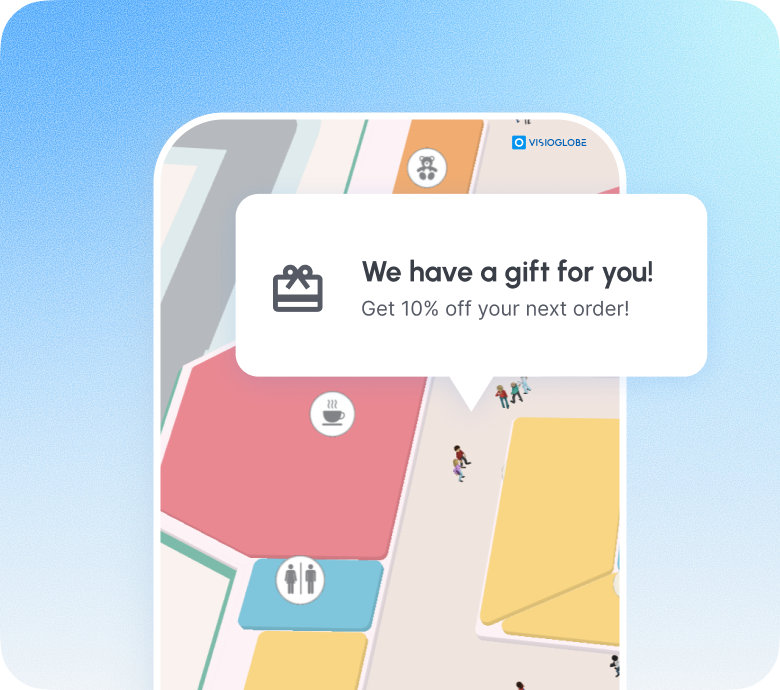
Now geofencing is inverting this dynamic, with the surrounding mall environment that "becomes aware" of the customer and can proactively deliver value at the right moment, in the right place. Here follow 3 concrete examples:
- A loyalty app pushing a time-limited offer as a shopper passes a specific, geofenced store.
- A monitoring dashboard flagging an unusually long queue at a food kiosk.
- A post-visit analytics report revealing that a significant share of visitors who entered via the North entrance never made it past the central atrium, this way providing insights of a conversion gap begging for a targeted marketing response.
Geofencing fosters the shift from passive indoor navigation to active, location-based engagement. And this is where indoor mapping technology genuinely contributes to improve the overall shopping experience and to boost commercial performance.
How to choose the right Geofencing solution for your shopping mall
If you are evaluating indoor geofencing for a shopping center, the questions worth asking go beyond "can it draw a zone on a map" or "what kind of information can I push to visitors". Here are some questions to back you up:
- How is indoor positioning achieved? (Wi-Fi, Bluetooth beacons, sensor fusion?) and what accuracy does it deliver in my specific mall building?
- Are geofences topology-aware or is the solution relying on flat 2D coordinates that ignore floors and walls?
- How are fences managed? Is the interface designed for non-technical venue teams, or does every change require developer involvement?
- What event types are supported and trackable? Entry, exit, dwell time thresholds, re-entry after a defined gap?
- Can the solution integrate with your apps, your tenant communication tools, your analytics stack? And how?
- What tracking and monitoring data is available? Can you tie geofence events to anonymised customer journeys for aggregate analysis across the shopping center?
These questions quickly reveal whether a platform has been actually architected to handle the complexity of a real indoor retail environment or whether it is a simpler tool hiding some operational challenges.
Visioglobe geofencing capability: indoor intelligence shaped for large shopping centers and beyond
Visioglobe is an indoor mapping and wayfinding solution built specifically for large, multi-level venues: shopping malls, smart buildings, airports, hospitals, parkings, universities campuses - to name a few. Its geofencing capabilities are natively built into the indoor map engine, meaning fences are always floor-aware, topology-aware and tied to the same data model that drives indoor navigation.
What does it mean for a retail manager? For mall directors and facility operators, this means a single platform that handles wayfinding for customers, zone monitoring for operations teams and location-based engagement for the marketing department. All grounded in the same accurate, maintainable floor plan. Also, malls' apps integrating Visioglobe interactive map technology can access real-time indoor positioning and navigation features alongside geofence-triggered notifications and offers, creating a seamless, connected shopping experience at every touch-point (kiosk, mobile, web).
Whether the goal is to improve the shopping experience, provide tenants with richer data or build the marketing intelligence to run a more efficient center, the starting point is common: a precise, real-time understanding of what happens inside your building. And the right tools to act on it. If that sounds like the foundation your shopping mall has been missing, it is worth exploring what Visioglobe's indoor mapping and navigation suite can do for your venue.