


Indoor Mapping key uses cases and ROI guide
This short guide highlights 4 proven, high-impact use cases where interactive indoor maps generate strong ROI.

Indoor mapping technology is rapidly reshaping the way organizations understand, manage and enhance their physical indoor spaces. Across a great variety of sectors - from retail environments to large corporate campuses - businesses are leveraging highly detailed 3D indoor maps to drive measurable improvements in operational efficiency, safety, navigation and overall user experience. This short guide highlights four proven, high-impact use cases where interactive indoor maps generate strong ROI. It also outlines how to evaluate which applications best support your organization’s strategic objectives and provides practical methods for quantifying the financial and operational returns you can expect from deploying indoor mapping solutions.
Real-world indoor mapping applications across 4 key industries
Indoor navigation solutions are proving their value across a wide range of industries, each facing unique operational complexities and user experience demands. By examining how leading sectors apply indoor positioning and intelligent mapping systems, it becomes clear how organizations translate these capabilities into tangible outcomes: from streamlined operations to improved safety and higher customer satisfaction. The following industry-specific examples illustrate not only the practical use cases but also the measurable impact indoor mapping can deliver at scale.
1. Retail and Shopping Centers: indoor mapping to optimize space leasing and drive higher engagement
More and more retail environments are leveraging indoor mapping for customer experience purposes, while simultaneously gathering behavioral insights that help support merchandising, layout optimization and targeted marketing strategies on site thanks to a data-driven approach.
On the final user side: an enhanced shopping experience thanks to the mall digitalization. In fact, interactive indoor maps with mall directories - typically available on mobile apps or on-site kiosks - enable shoppers to search for and locate specific stores, brands or product categories, then navigate directly to them taking the most adapted path (i.e. users accessibility needs). Also, indoor mapping makes it possible to set promotional notifications triggers as soon as visitors enter defined geofenced zones, hence delivering relevant offers that can directly contribute to increasing foot traffic to a specific store and its conversion rates.
Behavioral research shows that 78% of consumers find personalized messages based on geofencing relevant, with campaigns boosting store visits by up to 20%, demonstrating that location plays a crucial role when marketing to potential customers.
On the business side: the opportunity to boost mall’s efficiency and operations thanks to key data. Retailers typically analyze movement patterns indoors to understand each store's performance, measuring foot traffic and dwell time by zones, identifying hot and cold areas and evaluating promotional campaign effectiveness through behavioral changes. Such a data-driven approach stands at the basis of layout decisions, more precise staffing allocation and even space-leasing negotiations in multi-tenant shopping centers.
This helps mall’s operators optimize not only tenant positioning, but also rental rates based on stores actual location and performance with documented customer flow patterns.
2. Healthcare Facilities: indoor mapping to enhance patient experience and asset tracking capabilities
Hospitals are particularly challenging navigation environments, with their complex layouts, frequent renovations and visitors everywhere seeking specific departments under emotional distress. Meanwhile, operational demands require tracking expensive medical equipment, managing staff workflow and ensuring effective emergency management.
Indoor mapping for hospital patients and visitors is beneficial especially within complex structures to guide them to exact destinations with no extra stress. Patients get more efficiently to their appointments, this way reducing late arrivals that may disrupt scheduling efficiency. On their side, visitors can spot patient rooms, cafeterias, pharmacies, parking or any other available services without looking for staff assistance. Moreover, the right solution of indoor mapping for a complex healthcare facility also provides multi-language support and adaptive routing to serve users’ diverse needs: for example, routes minimizing walking distance for elderly people, barrier-free paths for wheelchairs and PRM.
For the healthcare facility efficiency itself, indoor mapping delivers a concrete tool to centralize and visualize crucial data, such as for medical equipment tracking and utilization purposes. A healthcare facility maintains thousands of mobile assets: infusion pumps, wheelchairs, portable diagnostic equipment and crash carts, amongst others. When connected to indoor mapping solutions, real-time asset tracking systems - for instance relying on Bluetooth Low Energy (BLE) beacons - empower staff to instantly see and locate required equipment, which drastically reduces time waste and potential collateral risks.
Industry takeaways aggregated by Market Growth Reports show that hospitals using asset tracking have recorded significant improvements, such as a 22% increase in asset recovery and reductions in unauthorized equipment use. As a consequence, this supports increased utilization and less redundant purchasing given that equipment becomes easier to locate and manage over time. Also emergency response times expect to improve when critical equipment location is immediately available during both evacuation drills and real-life occurrences.
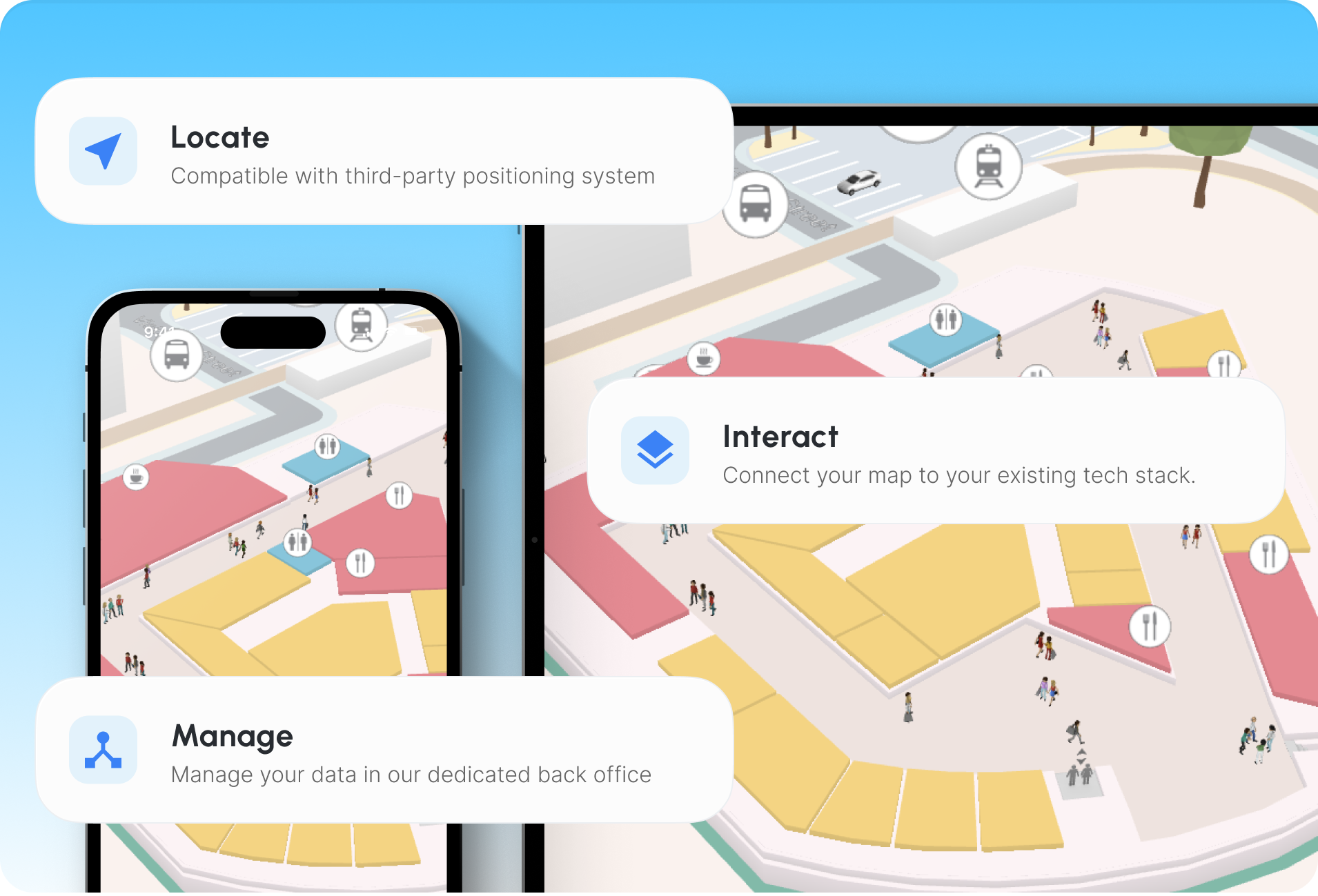
3. Corporate Offices and smart buildings: indoor mapping to optimize workplace efficiency
The evolution towards hybrid work has created new requirements for better space management and employee experience in corporate environments.
Indoor mapping technologies for smart offices that integrate with desk and meeting room booking systems, are becoming a game-changing tool both for the organization and its employees: on the one side, integrated indoor maps empower employees to quickly check real-time occupancy and find available spaces; on the other hand, companies gain a clearer view on real-time space occupancy and can take better decisions about layout optimizations and resources allocation to highly-frequented zones.
In fact, indoor maps integration with smart building technologies also provide a centralized monitoring view on the building energy consumption in real-time. Based on key occupancy data, companies can more easily plan and intervene for maintenance operations such as adjusting indoor spaces lighting and temperature. All this avoids energy waste and excessive costs in underutilized zones, while keeping optimum comfort and workplace experience.
Moreover, in large office buildings and campuses, relying on indoor mapping is key to help new employees and visitors navigate through such complex facilities and find in a few seconds the most adapted path to reach their destination (or even a precise referenced asset, such as the nearest available printer!).
4. Airports and Transportation Hubs: indoor mapping to boost passenger experience and operational efficiency
Airports, like any other extensive transportation hub, generate exceptional wayfinding complexity: passengers have to navigate multi-terminal facilities under time pressure, often in foreign languages, while managing luggage and sometimes coordinating with other trip companions.
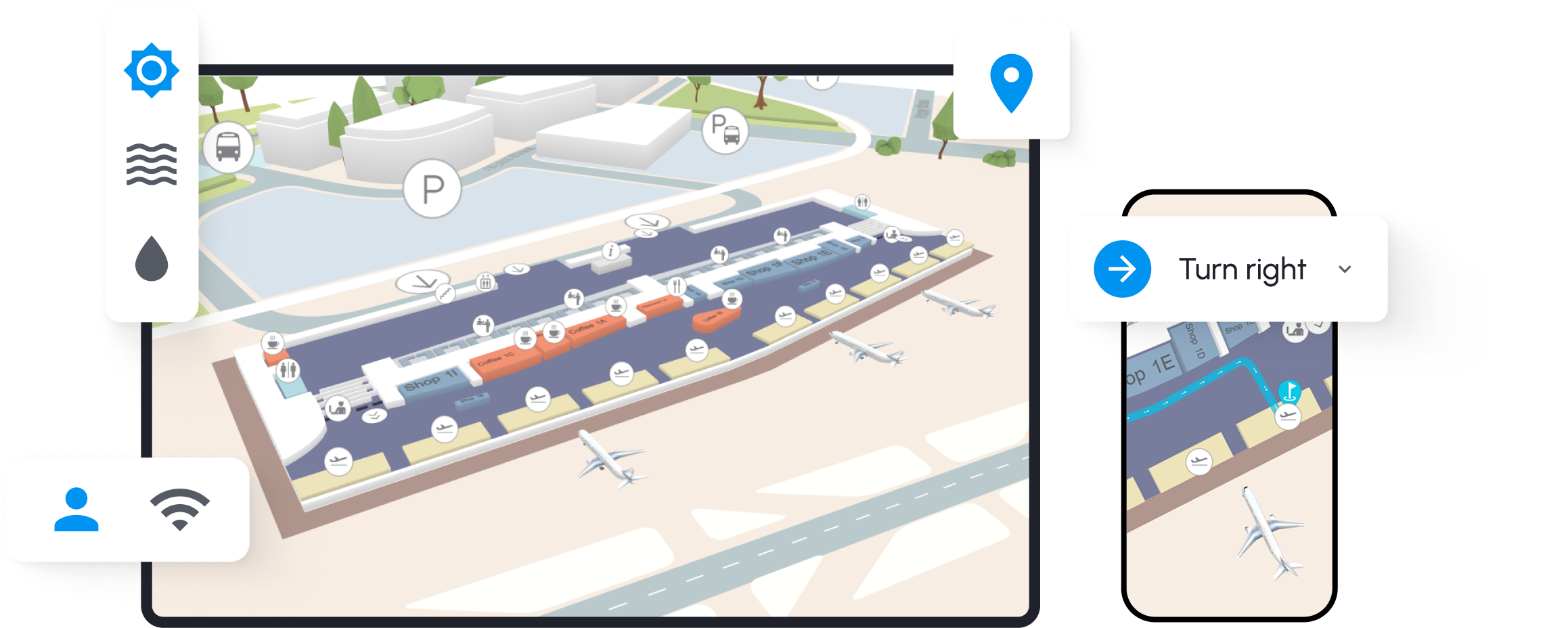
This is why more and more innovative airports are integrating modern indoor maps into their web and mobile applications: to ensure step-by-step guidance from passenger arrival and check-in to the gate, while reducing stress. In fact, by providing real-time routing adjustment with estimated arrival times based on bottlenecks, overcrowded areas, security wait times and even passengers’ accessibility needs (ex. barrier-free paths for PRM), a smart indoor mapping solution can definitely enhance the overall passenger experience.
And the benefits go far beyond. Airports and transportation hubs leverage indoor mapping for flow management and operational analytics, too. When integrated with IoT technologies, indoor maps unleash their full potential: thanks to real-time data streams, they enable facility managers to optimize layouts, adjust staffing levels, track assets and even more rapidly intervene in specific zones in case of an emergency.
Conclusion: capturing value at each step of your indoor mapping journey
Indoor mapping has moved far beyond its early experimental phase to become a trusted, real-world digital solution for modern buildings across industries. Today, organizations rely on indoor maps, indoor navigation, and positioning technology to enhance user experiences, streamline operations, and extract accurate insights from space and movement data. These capabilities help teams understand how resources are used, improve service delivery, and monitor environments with greater clarity.
Achieving this level of impact, however, depends on aligning technology features with clear business requirements and setting realistic expectations around accuracy, performance, and ongoing maintenance. The most successful implementations begin with well-defined objectives, validate their approach through proof-of-concept testing, and treat deployment as the start of continuous optimization—not the end. This mindset enables organizations to adapt quickly, increase operational efficiency, and support evolving use cases over time.
Whether you’re solving complex indoor navigation challenges, improving visibility with asset tracking, or driving data-informed space optimization, the right indoor mapping application will deliver measurable value. Choosing a platform that fits your building layout, user needs, and operational constraints ensures you can scale confidently and maximize productivity across your entire indoor environment.
💡 Wish to discover how interactive indoor mapping can help you achieve your business goals? Reach out to our experts and get a personalized demo.
