
Hospital Wayfinding Software: interactive maps to improve patient navigation & hospital operations
See how hospital wayfinding software and interactive indoor maps help patients and visitors navigate healthcare facilities effortlessly.

Every hospital has the same problem: patients and visitors get lost. Large healthcare facilities are built in phases over decades, with departments added long after the original floor plan was drawn; most of the time static signage can't keep up.
An advanced hospital wayfinding software solves this issue with an interactive indoor map that guides patients and visitors to the exact department they need, while providing hospital teams with a shared, real-time view of the building.
Why Hospital Wayfinding is a growing priority for hospital facilities
Healthcare facilities are some of the most complex buildings the public has to navigate. A single hospital campus can span multiple buildings and dozens of departments, each with its own signage.
For patients, that complexity means extra stress: arriving late, wandering a corridor or asking staff for help is a poor start to an appointment.
For the hospital, the complexity means losing focus on key work: losing time on giving directions, appointments delays at each department and overspending to keep signage relevant and updated at every floor-plan change.
An interactive indoor map, delivered through an app, kiosk or even website, removes most of that friction for patients, visitors and staff.
How Interactive Indoor Maps improve patient navigation
A hospital wayfinding solution isn't a single feature. It's a set of tools that work together to guide patients and visitors and reduce stress at every stage of a visit.
- Real-time, turn-by-turn navigation
Users search for a department, a service or a doctor by name and then get a real-time route on their phone, the hospital's website or kiosk. No more signs or color-coded floor lines to decode and lose time on.
- 100% venue accessibility for every visitor
The same map can automatically calculate step-free routes, so wheelchair users and anyone who can't go through stairs get an accessible route by default, not as a special request.
- Multi-platform availability and multilingual support
Because the map lives online, patients can find parking and check travel time before leaving home, lowering pre-appointment anxiety, thanks to hospital map's availability on multiple devices (hospital website and app). Plus, advanced indoor wayfinding systems also include language settings so visitors can easily pick their own language to get route instructions that they can more easily and confidently follow.
- Smooth third-party integrations with appointment-linked tools
When the platform integrates with scheduling, a confirmation text can include a direct link to the patient's exact destination. Together, these features change what discovering and navigating a hospital feels like:
- Patients find their destination without asking staff for help
- Visitors get accurate directions to a patient's room or a waiting area
- Wheelchair users and people with specific mobility needs get accessible routes automatically
- Non-native speakers get a route they can follow without a translator by their side
- Appointment reminders and location instructions reduce late arrivals
What Hospitals gain from a digital wayfinding platform
Improving the patient experience is the most concrete benefit. And the operational payoff is just as real, here's how:
- Less Staff Time Spent Giving Directions
When patients self-navigate, front-desk and clinical staff spend less time on directions and more time on care.
- Fewer Missed Appointments
Clear routing and pre-visit planning reduce late arrivals and no-shows.
- Higher Patient Satisfaction Scores
Wayfinding is one of the most visible, most complained-about parts of a hospital visit, which also makes it one of the easiest to improve quickly.
- Real Operational Data
An indoor map generates usage data — which routes get the most traffic, where visitors get stuck — that facilities teams can use to plan renovations or staffing.
- One easy-to-manage and cost-effective platform
A cloud-based back end lets staff update the map in minutes when a department moves, instead of reprinting signs across the facility. A hospital wayfinding platform typically helps a healthcare organization:
- Reduce staff interruptions for basic directions
- Lower no-show and late-arrival rates
- Improve patient satisfaction survey results
- Get real-time visibility into how the building is actually used
- Update maps centrally instead of managing physical signage
Beyond navigation, multiple indoor mapping use cases a hospital can leverage
Once a healthcare facility has an interactive indoor map, most hospitals extend it into other workflows.
Asset Tracking
Wheelchairs, infusion pumps and monitors have a habit of disappearing exactly when a nurse needs one. Tagging that equipment on the same map turns a floor-by-floor search into a lookup that takes seconds. As a result:
- Faster equipment retrieval during time-sensitive care
- Better visibility into what departments actually need more devices
- Fewer unnecessary equipment purchases
Energy and Building Management
The same map can integrate with a building management system to show HVAC zones (Heating, Ventilation, Air Conditioning), lighting and occupancy, giving facilities teams a spatial view of where energy is wasted.
- Easier identification of energy-inefficient zones
- Better support for sustainability targets
- Occupancy-based adjustments to heating, cooling and lighting
Security
A digital map of every entrance and restricted zone gives a security team a live picture of the facility, paired with access control and camera systems.
- Faster response to incidents in specific zones
- Better management of evacuation routes during emergencies
- Clearer monitoring of restricted-access areas
What to look for in a Hospital Wayfinding Solution
Not every wayfinding app is built for a healthcare facility at scale. To make sure you opt for the right indoor mapping solution for your business, here's a short list of key capabilities you should look for:
- A cloud-based platform that lets non-technical staff update the map without IT support.
- Open integration options to connect with scheduling, building management, security systems and any other central tool of your current ecosystem.
- Proven accessibility features, including step-free routing and multilingual support.
- Compatibility across multiple devices such as mobile app, kiosk and web platforms, so patients can smoothly switch from one to another as they wish.
- Analytics dashboards and/or raw data exports availability to turn wayfinding data into actionable insights and decisions.
💡Discover how healthcare facilities like Stamford Hospital leverage the Visioglobe wayfinding technology
Stamford Hospital is a renowned medical center located in Stamford, Connecticut, offering a wide range of advanced medical services, state-of-the-art facilities, and a dedicated team of healthcare professionals committed to providing high-quality care to patients.
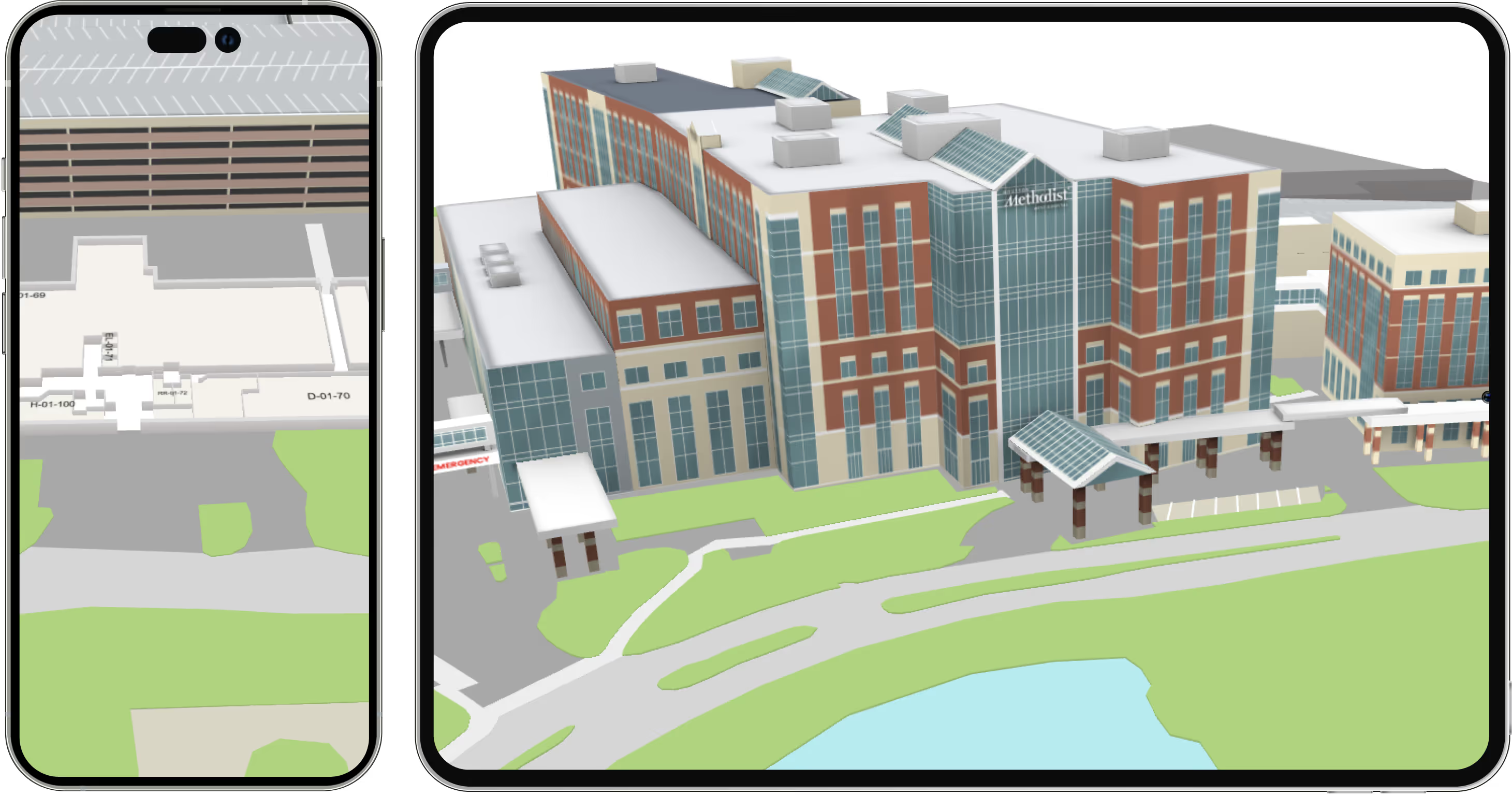
Map usage
Stamford Hospital uses Visioglobe indoor mapping technology in their application to enable smooth navigation for patients and visitors throughout the complex.
Challenge and solution
Stamford Hospital uses Visioglobe Indoor mapping to provide the best possible experience for visitors and patients, offering seamless navigation to different medical centers within the hospital.
Additionally, the hospital map is compatible with Google Maps, ensuring a smooth and optimal experience from home to the hospital's points of interest.
Key takeaways - Frequently Asked Questions (FAQ)
What is hospital wayfinding software?
A digital platform that turns a facility's static floor plans into an interactive indoor map, so patients can search for a destination and get real-time directions on a mobile app, kiosk or website.
How do interactive indoor maps help patients?
Interactive indoor maps directly contribute to reduce visitors stress by helping patients find a destination without losing time, waiting for staff assistance. This way the hospital facility let people plan a route even before they arrive.
Can hospital indoor maps be used for more than navigation?
Hospitals can definitely leverage interactive indoor maps to go beyond mere navigation. Indoor mapping technology is commonly extended to asset tracking, energy management and security strengthening within busy healthcare infrastructures.
Do hospital wayfinding apps work on mobile devices?
The most advanced indoor wayfinding solutions like Visioglobe support mobile apps, kiosks and web browsers, so that users can start a route on one device and finish navigating on another on-site.
The bottom line about hospital indoor wayfinding solutions...
Interactive indoor maps start as a fix for a visible problem: patients getting lost in a complex healthcare facility and consequently bottlenecking operations. But the same real-time location data that guides a patient to cardiology can also find a missing infusion pump, flag an energy-inefficient wing or lock down a corridor during a security event... a cost-effective, performance-driven platform that keeps paying off long after launch.