Indoor Mapping: 4 levers to maximize your mall's ROI
A well-deployed indoor mapping solution generates value across multiple dimensions. Here are the 4 levers, with the metrics that actually matter.

When most people think about interactive mapping in a shopping mall, they picture a wayfinding kiosk or a store locator on a phone app. Useful, sure. But that framing barely scratches the surface.
A well-deployed indoor mapping solution generates value across four distinct dimensions and the mall operators who've understood this, use it as a genuine performance management tool.
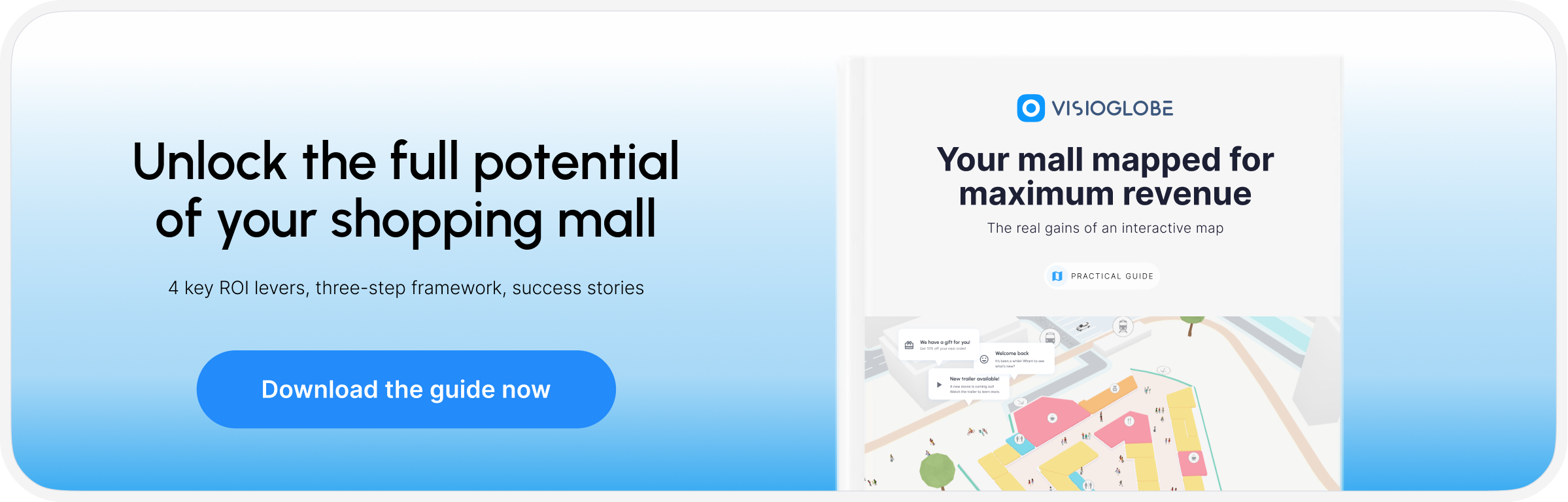
From the guide "Your mall mapped for maximum revenue", here are the four levers with the metrics that actually matter.
Lever 1: More time in the mall = higher purchase potential
The logic is straightforward: a shopper who navigates easily explores more. They discover stores they wouldn't have found on their own, extend their visit, and create more opportunities to spend.
Malls that have deployed indoor navigation solutions report an average 10–20% increase in dwell time within the first six months of go-live. On a $45 average transaction value with 30,000 weekly visitors, even a modest improvement in conversion rate adds up to tens of thousands of dollars in incremental revenue per week.
Advanced solutions go further with built-in geofencing: a retailer can push a targeted promotional offer at the exact moment a shopper walks past their storefront. That's the shift from broadcast marketing to precision marketing — the right person, in the right place, at the right time.
🎯 KPIs to track: average dwell time, number of stores visited per shopper, average transaction value per visit.
Lever 2: Footfall data to optimize space leasing revenue
Without real data on visitor flows, managing your tenant mix largely comes down to assumptions and gut feeling. Meanwhile some zones stay undervalued not because they lack appeal, but because their potential has never been measured.
An advanced indoor mapping platform gives access to real footfall data, zone by zone, hour by hour. This way mall managers can more easily justify premium rents with concrete traffic figures, offer incoming tenants a strategic placement backed by measured flow data as well as demonstrate to existing tenants the tangible value your property delivers.
Operators who use footfall data to drive their leasing strategy report a 5–15% improvement in rental revenue over 12 to 18 months.
🎯 KPIs to track: footfall by zone and time period, leasing revenue evolution, tenant retention rate.
Lever 3: Immediate reduction in operating costs
This is often the fastest lever to activate and the easiest to defend in front of a CFO.
No more print runs every time a tenant moves. No more waiting on physical installation teams. No more IT dependency to update a floor plan. With a solution like Visioglobe, mall operations team can update the map in minutes from a single editor, with changes instantly reflected across all your platforms: mobile app, website and kiosks simultaneously.
Shopping centers switching from static signage to a digital solution reduce their wayfinding budget by 30–60% in year one. On a $40,000 annual signage budget, that's up to $24,000 saved, immediately.
🎯 KPIs to track: signage budget before vs. after deployment, average map update turnaround time.
Lever 4: Long-term loyalty through visitor experience
A shopper who enjoys a smooth navigation experience doesn't just leave with their purchases. They leave with a reason to come back.
Interactive mapping also addresses every visitor profile: accessible routes for people with reduced mobility, multilingual navigation for international shoppers and an intuitive interface for those less comfortable in complex spaces. This isn't a nice-to-have — it's a concrete commitment to inclusion, an increasingly decisive factor for the retailers and partners choosing where to operate.
Malls that have deployed an accessible navigation solution report a 15–25 point improvement in visitor NPS within 12 months of deployment.
🎯 KPIs to track: visitor NPS, return visit rate, average Google/TripAdvisor rating.
Build your business case with levers that don't work in isolation
That's the real strength of a well-integrated indoor mapping solution: it doesn't optimize a single line of your results. It simultaneously strengthens your revenue, your leasing value, your operational efficiency, and your visitor loyalty.
For each lever, clear metrics, industry benchmarks measured across our client base, and a framework to calculate your own ROI.
Want to go further and build your business case?
Our guide "The ROI of Interactive Indoor Mapping" compiles these benchmarks, the KPIs to track for each lever, and a 3-step framework to build a compelling internal business case, tailored to every stakeholder.