
Why Airport Passenger Experience depends now on interactive indoor maps more than ever
Explore how a guest-grade digital wayfinding solution becomes an efficient, measurable driver of attractiveness and reputation across airports.
A passenger landing with 90 minutes to catch their connecting flight. The gate has changed, the signage points two possible directions at once and staff is not available to assist immediately. By the time passengers finally find their way, the duty-free shop, the lounge they paid for and the calm they wished they had before boarding are all gone.
This scenario happens daily at airports of every size, while travelers now compare their airport journey to the polished digital experiences they get from hotels, retailers and airlines. A printed map and static signage were never built for that comparison, and the industry is noticing.
For airport operations leaders, this shift isn't just a passenger-comfort issue. It's an operational and commercial blocker. A confused passenger not only misses flights; they skip retail and dining experiences, leaving with a weaker impression of the airport itself. This short article looks at how interactive indoor maps close the passenger experience gap as well as why guest-grade digital wayfinding solutions are becoming an efficient, measurable driver of attractiveness and reputation across any airport.
The Airport Passenger Experience: a journey starting way before reaching the gate
Airport operators are increasingly considering travelers as "guests," not just passengers moving through a checkpoint. And guest expectations,shaped by hospitality essentials, should be taken into account: personalization, clarity and a sense of being taken care of, as part of today's airport guest experience infrastructure.
Across airports, a strong guest experience means a passenger easily knows three things at any time: where they are currently, how long it takes to get to their chosen destination and what are the available services around them to enjoy along the way. Interactive indoor maps make that possible by turning a static layout into a live, guided process: turn-by-turn routes from terminal to gate, live walk times, barrier-free routing, security wait indicators and points of interest (POIs) surfaced exactly when they're relevant - whether that's a pharmacy, a nursing room, a contact point for lost baggage or a currency exchange desk. This active support, serving as a traveler's companion, helps any passenger reduce confusion and improve venue exploration with confidence.
For airports adopting this premium guest experience, the payoff isn't only fewer missed flights. It's calmer, more confident passengers spending more time engaging with the airport venue instead of anxiously running to search for their gate.
One seamless passenger journey at every airports touch-point
In today's busy airports, travelers don't experience the indoor venue through one single screen. Instead, they check a kiosk at the entrance, glance at their phone mid-journey and might return to a digital directory near their gate. If each of these platforms show a different map, a different layout or outdated information, the airport experience feels fragmented.
Omnichannel wayfinding solutions keep kiosk, mobile and web systems perfectly aligned, so the interactive map a passenger sees at check-in matches exactly what they see on their phone. This is the point: a passenger moving from check-in to security to the gate should feel like they are on one seamless, efficient journey. This consistency is what makes self-service navigation actually usable and game-changing at scale, especially across airports with dozens of touch-points and thousands of daily passengers.
When Geofencing ensures precision without intrusion
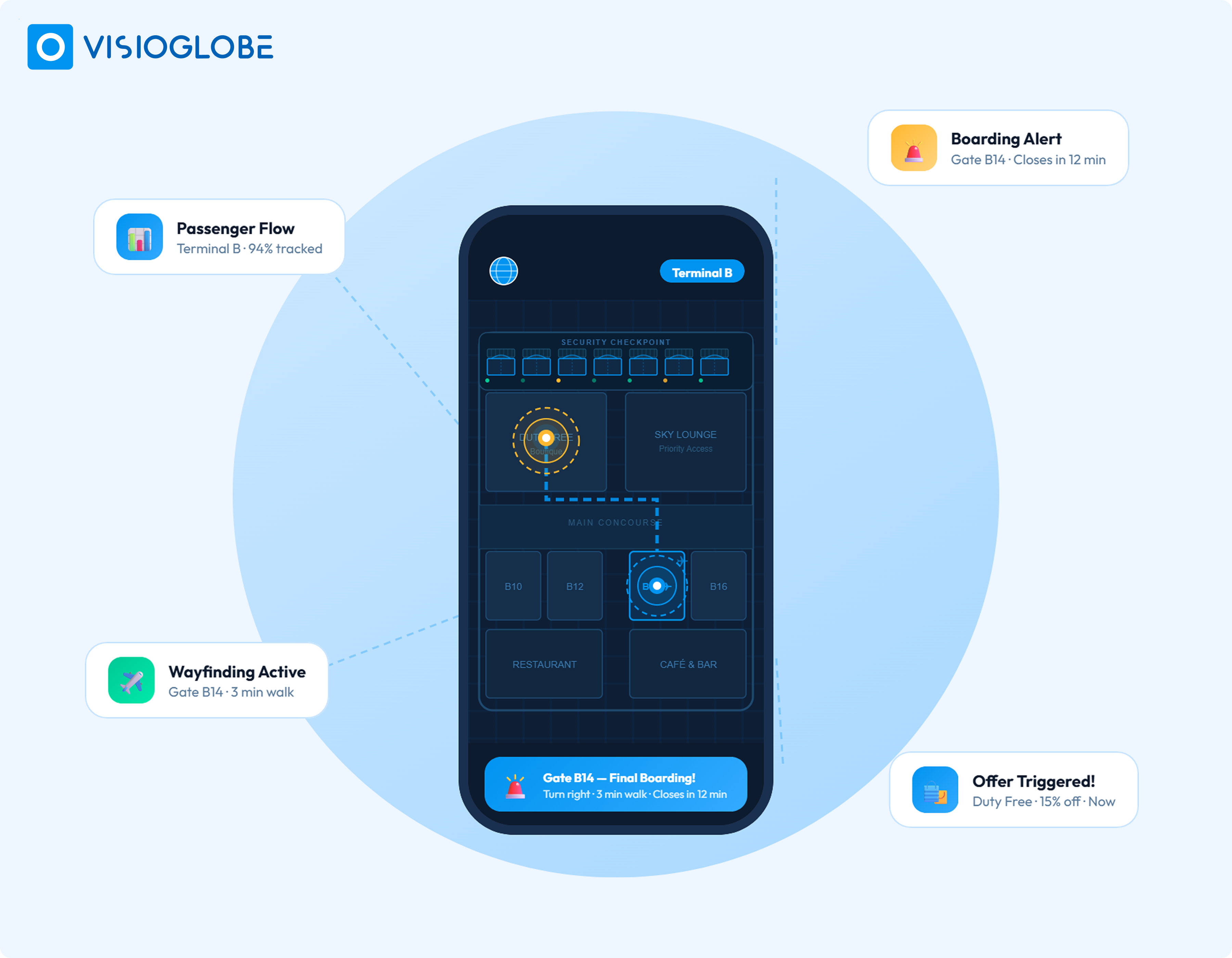
Geofencing adds a layer of intelligence to the interactive map by tying information to location, not just to a screen. As a passenger moves through the airport terminal, digitally defined zones trigger and push the right message at the right moment: a gate-change alert if they're heading toward the wrong lounge, a boarding reminder as departure time approaches or a duty-free offer as they pass by a shop matching their interests.
When deployed efficiently, geofencing works autonomously in the background. It doesn't interrupt the journey: it anticipates it, shifting the passenger experience from passive information display to an active journey that feels genuinely enjoyable and useful in real-time. And because zones and triggers are defined by the operations team, airports gain precise control over what reaches passengers, where and when; all this, without adding friction to their stay.
Turning airport interactive navigation into a revenue and reputation lever
For airport management, passenger experience and commercial performance are the same conversation industry -wide. Every minute a passenger spends confused within a terminal is a minute they are not spending at a retail counter, a restaurant or a lounge. And this industry -related revenue is one of the largest levers airports have to improve profitability besides flight volume.
Advanced airport mapping systems directly support this goal. Because when travelers can see exactly what's available and how far it is, they're more likely to explore rather than heading straight for their gate. Thanks to an advanced indoor map, retail and dining locations become discoverable and airport operations teams gain visibility into which zones passengers actually visit; the kind of performance data informing tenant placement and staffing allocations. This is also where efficiency in airport management pays off and can reduce missed flights during peak business travel.
Interactive airport maps also reflect a key brand dimension. A premium, polished digital map signals a modern, well-run airport before a passenger even steps off the airplane bridge. Airports competing for airline partnerships, retail partners and passenger satisfaction rankings are leveraging their digital customer experience more than ever, making it a visible part of that competitive positioning and innovative infrastructure, rather than a "simple" back-office tool.
What makes an interactive indoor maps really "premium" in today's airport industry
Not all indoor maps deliver top-notch passenger experience. Many are built from generic library assets that look flat, feel disconnected from the venue's real architecture and are difficult to update once launched: a real problem in a busy airport environment where gates, retail shops and layouts can quickly change.
This is where Visioglobe's approach differs: rather than relying on flat AI-generated surfaces or templated assets, industry experts hand-crafts custom 3D indoor maps using proprietary mapping technology that reflects the actual look and feel of a venue, giving passengers a real sense of orientation the moment they see the map. To grand the airport map stays always fresh and reliable, airport management teams can easily publish updates themselves: simultaneously on kiosk, mobile and web platforms, without waiting on developers or extra IT resources. In other words, choosing Visioglobe also means less reliance on outside vendors and more control over day-to-day service, which is a meaningful efficiency gain for any business running a high-traffic, global hub with steady business travel. Such premium interactive maps reach their full potential when connected to your technology ecosystem: behind the scenes, an analytics dashboard can be displayed to monitor people flux and turn passenger movement into operational insight. This helps, for instance, facility teams learn which zones perform well and where friction still exists, using existing resources.
A technology designed to foster airport guest experiences
The underlying technology is designed to enhance, not replace, customer care from airport staff. As international air travel continues to grow, the aviation industry leaders are increasingly considering indoor mapping systems as core infrastructure, rather than a nice-to-have tool.
It is no mystery: security screening and passport control are tightly regulated processes airports can't change overnight; but wayfinding is one of the few passenger-facing touchpoints an airport can improve quickly to benefit its revenue as well as market reputation, without changing any core processes.
Built on 20 years of experience with large, complex venues (including hospitals, retails parks, university campuses and international transit hubs), Visioglobe's indoor mapping platform is designed to be expert-crafted at launch and effortless to manage afterward. It's a map built to evolve with business needs and operations across airports.
Interactive indoor maps bringing it together in airports
Airport passenger experience is no longer just about signage and staff: it's a key piece of digital infrastructure that shapes how passengers move, spend and remember the venue. Interactive, omnichannel indoor maps, supported by geofencing and backed by real operational data, turn navigation from a source of stress into a quiet, enjoyable driver of both passenger satisfaction and higher revenue.
To learn more about how a premium indoor mapping platform could specifically support your airport's passenger experience and attractiveness goals, book a demo below with one of our Visioglobe experts to see a custom 3D airport map in action.