
Why Indoor Mapping is a game-changer for shopping malls
Indoor mapping technology is fundamentally reshaping how malls operate, how visitors navigate and how tenants perform. Check this out.
Lost shoppers don't buy. Frustrated visitors don't come back. And underperforming zones cost everyone, from mall operators to tenants. In today's competitive retail landscape, the way you guide shoppers through your spaces directly impacts your revenue, your tenant satisfaction, and your long-term commercial performance.
Shopping malls are complex ecosystems. Hundreds of stores, multiple floors, sprawling car parks, food courts, cinemas and service points: all competing for a visitor's attention, time, and money. Yet the tools guiding people through these spaces have remained almost unchanged: static floor plan displays, paper leaflets and the occasional help desk.
That era is over. Indoor mapping technology is fundamentally reshaping how malls operate, how visitors navigate, and how tenants perform. Here's why it's not just a digital upgrade: it's a genuine game-changer for every shopping mall that wants to stay ahead.
The Hidden Cost of Poor Navigation in a Shopping Mall
Before exploring solutions, it's worth understanding what poor navigation actually costs a shopping mall — because these costs are real, measurable and largely invisible on a balance sheet.
A visitor who can't find a store doesn't always ask for directions. They give up. They leave. And in a mall of 30,000 weekly visitors, if just 5% abandon their search due to poor navigation, that's 1,500 missed store visits per week and thousands of lost purchase opportunities every month.
Then there's the cost of paper signage, instantly obsolete every time a tenant moves, closes or a layout changes. Doing nothing has a price. And that price compounds every week, every month, every year that your venue operates without a smart indoor navigation solution.
What Is Indoor Mapping and why does it matter for malls?
Indoor mapping is the technology that transforms static floor plans into interactive, intelligent, and navigable digital environments. Think of it as Google Maps — but for inside your building. It gives shoppers the power to find any store, service, or space in seconds, using intuitive turn-by-turn directions on their own smartphone or via an in-mall interactive kiosk.
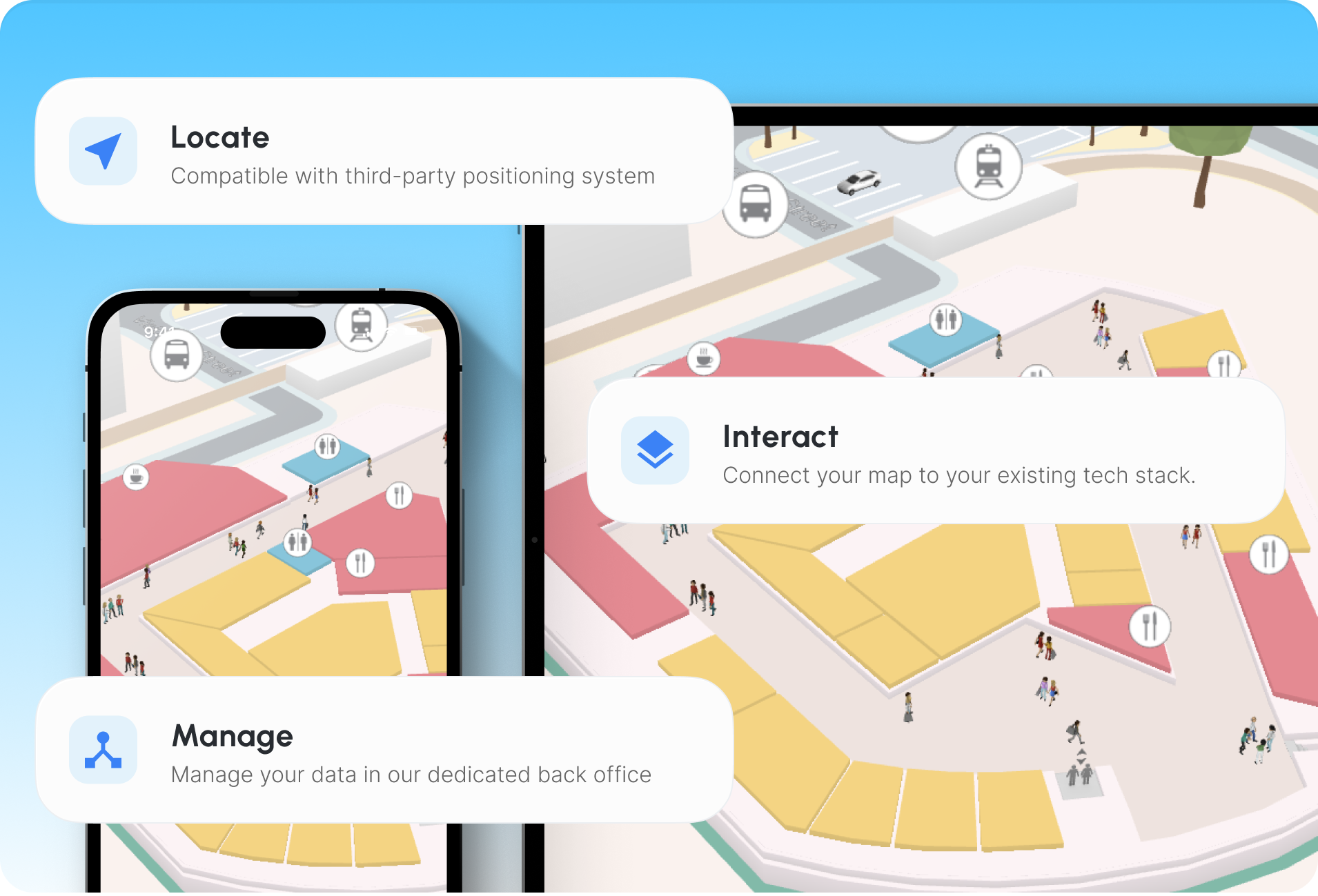
At its core, a modern indoor mapping platform like Visioglobe delivers stunning 2D and 3D maps of your venue, accessible across mobile apps (iOS & Android), web browsers and interactive kiosks; all from a single, unified map that can be updated in minutes and published everywhere simultaneously.
But indoor mapping is far more than a digital directories solution. When connected to indoor positioning systems, analytics platforms, and geofencing tools through a trusted ecosystem of technology partners, it becomes the central intelligence layer of your entire venue — a seamless operating system for the modern mall.
5 Reasons why Indoor Mapping is key for Shopping Malls
1. Turn foot traffic into revenue
Navigation and revenue are more connected than most operators realise. When shoppers can find any store in seconds — through intuitive turn-by-turn guidance on their own smartphone — they explore more, discover more, and potentially spend more. Studies consistently show that longer dwell times correlate directly with higher spend per visit.
Combined with geofencing capabilities, indoor mapping becomes a precision marketing engine. As a shopper walks past a particular store, a targeted offer lands on their phone at exactly the right moment — when intent to purchase is at its peak. This isn't mass marketing. It's contextual, location-aware engagement that converts.
The business impact is tangible and measurable. Mall operators who deploy a modern indoor navigation solution typically observe:
• Higher footfall to underperforming and hard-to-find stores
• Measurable improvement in tenant conversion rates
• Increased uptake of personalised offers and promotions via the mobile app
2. Make every space of your mall work harder
Not all zones in a mall perform equally and without real data on how visitors move through your spaces, optimising your commercial layout is hard to guess.
When integrated with foot traffic analytics solutions, indoor mapping transforms your floor plan into a live intelligence dashboard. You can see exactly which zones generate the most footfall, identify chronically under-visited areas inside the mall, track visitor flow patterns between floors and sections, and use this data to make strategic decisions about tenant placement, promotional positioning and space allocation.
For leasing teams, this is transformative. Instead of negotiating rent based on intuition and historical precedent, you now have precise, real-world data to justify premium rents, demonstrate value to tenants and build a commercial strategy backed by evidence rather than assumption.
3. Improve accessibility and inclusion for all visitors
Accessibility is no longer optional. It's a legal, ethical, and commercial imperative. Multi-modal routing ensures that visitors with reduced mobility, elderly shoppers, parents with pushchairs or international visitors navigating in their own language all receive the same quality of wayfinding experience. Seamless and without friction.
With an indoor navigation app that supports multiple languages and accessible routes, your shopping mall sends a clear message: every visitor is welcome and valued. This inclusivity directly enhances visitor satisfaction and supports the kind of repeat visits that build long-term loyalty.
4. Deliver experiences that build visitor loyalty
In a world where e-commerce offers unlimited choice from the comfort of home, physical retail must justify the trip. The differentiator isn't just the product mix: it's the shopping experience. And smooth wayfinding is a foundational part of that experience.
A visitor who navigates confidently, finds what they need without stress and feels that the mall has invested in their comfort is a visitor who comes back — and hopefully brings others with them. The connection between easy, frictionless wayfinding and customer loyalty is direct. In competitive retail markets where destination choice is wide and loyalty is hard-won, that kind of improvement is a genuine strategic advantage.
5. It streamlines mall operations and reduces costs
Beyond the shopper-facing benefits, indoor mapping delivers significant operational gains that improve efficiency and reduce unnecessary costs across your teams.
Staff and security teams spend a surprising amount of time answering direction questions. With a robust self-service indoor navigation app and clearly positioned kiosks throughout the mall, visitors can find their own routes in seconds, freeing your teams to focus on higher-value tasks.
For example: Asset tracking integrations allow facility teams to locate equipment instantly. Emergency management solutions use the indoor map as a real-time evacuation command centre. Maintenance teams can be routed via the most efficient paths inside the mall. The operational ROI is real, measurable and delivers value far beyond the visitor experience.
Beyond Navigation: a fully connected mall to drive growth
The most forward-thinking mall operators understand that indoor mapping is not a standalone tool — it's a platform. When connected to the right technology partners, it becomes the operating system of your venue.
The indoor map becomes the single source of truth — the visual hub through which every operational, commercial, and visitor-facing system in your shopping mall communicates and delivers value. Key integrations include:
• Indoor positioning systems: Add live blue dot navigation so shoppers always know where they are inside the mall.
• Foot traffic analytics: Visualise visitor behaviour directly on the floor plan to optimise space usage and commercial layout.
• Geofencing and contextual offers: Deliver personalized promotions to shoppers in real-time, based on their location inside the mall.
• Asset tracking: Enable facility teams to locate equipment instantly and improve operational efficiency.
• Emergency management: Use the indoor map as a real-time evacuation command centre for security and safety teams.
• Loyalty programmes and booking systems: Connect seamlessly to deliver a cohesive, personalised shopping experience from parking to purchase.
How to Choose the Right Indoor Navigation Solution for Your Mall
Not all indoor mapping solutions are created equal. When evaluating platforms, here are the key criteria to assess:
1. Multi-channel support: Does the platform deliver a consistent experience across mobile apps, web and kiosk from a single map source?
2. Real-time update capability: Can your team update store information, routes, and content instantly — without IT involvement?
3. Integration ecosystem: Does it connect easily with your existing analytics, loyalty, and operations platforms through open APIs?
4. Accessibility features: Does the solution support multi-language content, accessible routing, and inclusive wayfinding for all shoppers?
5. Proven results: Can the vendor provide case studies, clients references and a clear path to ROI for shopping malls like yours?
The bottom line: Indoor Mapping is now foundational infrastructure
Indoor mapping is no longer a nice-to-have feature for tech-forward shopping malls. It is foundational infrastructure for any venue that takes visitor experience, operational efficiency, and commercial performance seriously.
The malls that will win the next decade of retail competition won't be those with the most stores or the largest car parks. They'll be the ones that make every visitor feel guided, valued, and genuinely at ease — from the moment they walk through the door to the moment they leave, already planning their next visit.
Indoor mapping is how you build that advantage. And with the right platform, it's closer — and more accessible — than you might think.