
Indoor Wayfinding in Shopping Malls: why indoor navigation has become a revenue driver
Indoor wayfinding in malls is no longer a facility issue. It rather embodies a powerful business lever. Check out why and how.
Shopping malls have spent decades perfecting their tenant mix, their architecture and their marketing. Yet one of the most direct touchpoints with every visitor, as soon as they walk into a shopping mall and need help finding something, has largely remained stuck in the era of printed directories and static floor plans.
That gap is closing fast, thanks to interactive indoor mapping technology. And the shopping malls adopting it are seeing results that go well beyond "better indoor navigation."
Why Indoor Wayfinding is no longer a facilities issue
For most mall operators, indoor navigation is historically owned by the facilities team and actually embodies a cost center: print the map, install the directories, repaint the signage when specific services are no longer available or when stores move out. A quite functional system, but definitely annoying for its continuous and (very) expensive maintenance.
Moreover, shopper behavior has been changing fundamentally. Visitors arrive at the shopping mall having already browsed the center online. They know which stores they want to explore, sometimes even which specific products to look for and try. So today, what shoppers really need from the physical environment is frictionless, efficient navigation: find stores in seconds, find products without wandering and feeling lost, find the quickest way out (also and foremost when they get by car). Any friction in this customer journey is no longer tolerated, because the alternative (aka online shopping and home deliveries) is always one tap away.
In the end, this is partly why indoor navigation shifts from a facilities question to a customer experience question, hence becoming revenue-critical for every mall.
The hidden costs of not having a Digital Indoor Navigation solution
Before making a case for investing in an indoor mapping solution, it's worth naming what the absence of indoor navigation actually costs. There are at least 4 costs that do not appear as a single line in the P&L statement, but that are worth checking out:
1. Lost footfall inside the venue
A significant share of shoppers who can't find what they're looking for don't ask for help. They give up and leave, sometimes entirely skipping a significant part of the shopping mall. In a center welcoming tens of thousands of shoppers per week, even a 3-5% abandonment rate on planned visits translates into thousands of missed purchase opportunities weekly; then multiply across 52-53 weeks and the average basket lost value is huge.
2.Paper signage inaccuracy and spending
Physical wayfinding has a recurring cost that mall operators often underestimate until they take the time to measure it: printing, installation, removal and the periods in between where the maps are simply wrong. A tenant shuffle, a pop-up installation, temporary construction blocking a corridor: each one of these situations creates a version of the indoor spaces that exists physically but isn't reflected on any maps shoppers can access. Such a credibility gap undermines trust in the whole infrastructure.
3. Staff attention absorbed by navigation queries
Guest services teams, security staff and reception teams deal with the same "where is..." questions too many times per day. These interactions are rarely tracked as a productivity cost, but they are one. More importantly, they represent the experience floor for shoppers who need help and can't find directions digitally through an interactive indoor map or the mall's mobile app.
4. Underperforming zones
Without data on how shoppers move through the mall space, decisions about tenant placement and zone management are made on intuition or historical assumptions. Dead zones stay underused because there's no visibility into why they're underperforming: whether it's a navigation issue, a signage issue or a real commercial blocker.
📘 Guide: Your mall mapped for maximum revenue
Ready to build a business case your CFO, operations director and marketing team will all buy into?
Visioglobe's practical guide walks mall operators and retail park managers through a proven framework for measuring and demonstrating the full return on an indoor wayfinding investment. From hidden cost analysis to benchmarked ROI across signage savings, visit duration, tenant retention, shopper satisfaction and overall customer experience.
Inside, you'll find the KPIs that matter, stakeholder-specific arguments and real-world benchmarks and examples.
What Interactive Indoor Wayfinding actually improves
A well-designed interactive navigation platform supports mall in 4 distinct ways; and each with measurable commercial outcomes.
📈 It increases dwell time and sales
When all shoppers can navigate a mall confidently and discover stores they weren't originally looking for, they stay longer. Industry benchmarks suggest average visit duration increases of 10 to 20% within the first 6 months of deploying an interactive indoor navigation solution. Longer visits correlate directly with higher average spend per visitor.
📊 It generates first-party behavioral data
An indoor mapping platform doesn't just guide shoppers: it can track how they move. Which corridors are used most? Where do shoppers consistently bypass certain stores? Which zones attract heavy foot traffic at 11am but empty out by 2pm?
Such key data and insights transform space leasing from a commercial judgment call into a data-informed decision. Mall operators can more easily justify premium rents with actual foot-traffic evidence rather than proximity-to-entrance assumptions.
💰It reduces operational costs
Transitioning from physical signage to a centrally managed tool of indoor maps eliminates most of the recurring cost of maintaining the navigation infrastructure. Updates that previously took days - for coordinating print production, physical installation, removing outdated panels - can be made in minutes across every channel simultaneously (mobile app, website and in-mall interactive kiosks).
👍It improves tenant satisfaction and retention
Tenants care deeply about foot traffic. And the mall operator who can demonstrate, with real navigation data, the footfall a store generates is in a fundamentally stronger position when renewal conversations come around. On the contrary, if a store is underperforming, insights from the indoor navigation system may reveal a fixable cause or not before a tenant decides whether to renew.
The Technology behind interactive mapping: what to look for in an indoor mapping solution
Not all indoor mapping platforms are the same and the technical choices made at implementation define how much value a system can deliver over the long run. Good interactive mapping solutions are built with services and technologies that are easy for an in-house management team to run without ongoing vendor involvement, and thoughtful design decisions made early to improve outcomes for years afterward.
- 3D indoor maps matter more than they might seem
Two-dimensional floor plans are cognitively harder to navigate: shoppers have to mentally orient themselves and cross-reference their physical position with an abstract top-down map. 3D indoor maps of a mall's actual environment significantly reduce that cognitive load, particularly in multi-level shopping malls where the transitions between floors are rarely intuitive from a flat layout.
- Multi-channel deployment becomes non-negotiable
An indoor navigation solution that only works on a dedicated kiosk misses most of the opportunity. Shoppers are used to looking for anything they need via their phones. As a consequence, today's interactive maps need to be accessible through the shopping center's mobile web app or website, without requiring a new download.
- Accessibility routing has moved from a nice-to-have to a compliance and commercial consideration
A system that can automatically guide around steps, escalators and temporary obstacles serves a broader audience and reduces the liability exposure that comes with inadequate navigation for shoppers with mobility constraints (PRM, wheelchair users, elderly audience...).
- Real-time update capability determines the operational value of the platform
If updating a listing requires submitting a ticket to a technical team, the indoor mapping system will perpetually lag behind commercial reality. The operations team needs to be able to make changes to their indoor maps themselves, immediately.
- Location-based features and AI extend the value further
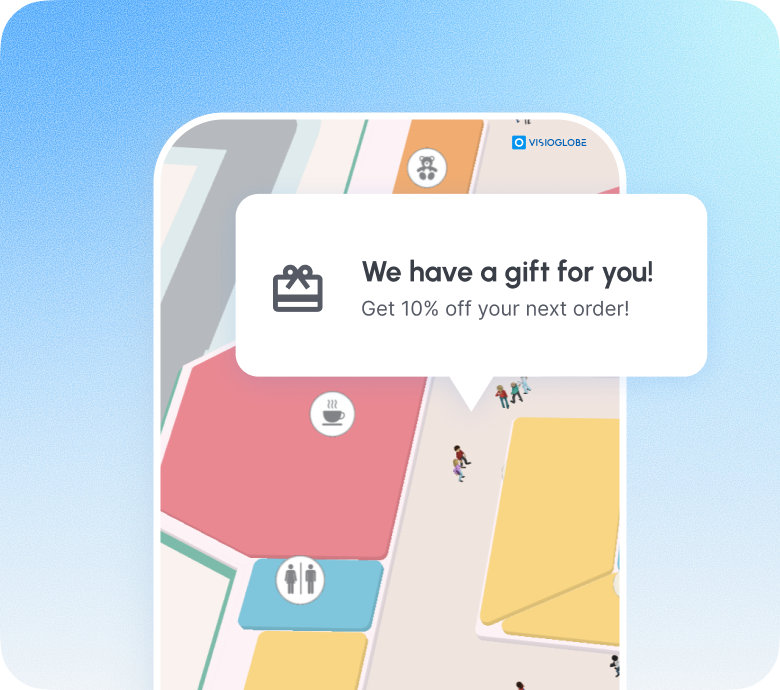
Location-based notifications (aka indoor mapping solution with built-in geofencing capability), personalized routes and AI-assisted search let a mall turn its indoor maps into a promotional channel: dynamically displaying promotions, events and amenities to shoppers based on where they actually are, not just where a generic ad assumes they might be.
Indoor Wayfinding benefits at a glance for 4 key mall stakeholders
- For shoppers and customers: easier navigation, faster store search, clearer directions, accessible routes and a smoother overall shopping experience that's easily managed even from a phone.
- For mall operators: lower printing costs, real-time updates, better space and traffic management and a scalable indoor navigation platform across the whole mall complex or retail park.
- For mall tenants: stronger foot-traffic evidence, better positioning insights and a data-backed case for renewal or expansion.
- For marketing teams: location-based promotions, behavior-based segmentation and a direct channel to reach shoppers already inside the venue as well as to continuously improve customer experience based on a data-driven approach.
How the right Indoor Wayfinding solution supports every team in the shopping mall
Indoor wayfinding is no longer a single tool embedded into a mall's website. It has become a piece of core retail technology that touches nearly every department. And the way each team leverages it, can be quite different.
Here follow the 4 main use case examples:
- Operations teams use interactive navigation to keep every tenant listing, corridor and services accurate. An efficient indoor mapping platform makes it easy to update a mall's digital map the same day a tenant closes or a new one opens, instead of relying on printed signage that takes weeks to reprint. This is one of the simplest ways an indoor navigation solution can improve day-to-day management: fewer manual processes, fewer inconsistencies between printed maps and the real property and navigation systems the team can manage in-house, without tech help.
- Customer service teams benefit just as directly. When shoppers can easily find directions, opening hours and tenant information themselves through an app or kiosk, staff spend fewer hours repeating the same directions and more effort helping customers with higher-value requests. Many shopping malls report that customer service queries around basic "where is..." questions drop noticeably once an efficient indoor navigation solution is in place, freeing staff to provide better customer service to visitors who need real assistance.
- Marketing teams use the same underlying technology to enhance the shopping experience with proximity-triggered promotional content: a notification about a promotion as a customer walks past a specific store, a map highlighting seasonal events or a personalized route feature that surfaces stores based on past behavior. These location-aware actions help create an always-on channel that reaches customers exactly when they're ready to buy.
- Leasing and analytics teams rely on the data that indoor navigation produces to make better decisions about tenant placement, rent and the overall retail mix. Foot-traffic analytics, dwell-time reports and route insights give a mall the same kind of information an e-commerce retailer gets from web analytics: the kind of information that used to be nearly impossible to capture inside a complex space like a large shopping mall.
💡NOT TO FORGET: Parking is often a shopper's first and last interaction with a mall and it's increasingly part of the same wayfinding solution: guiding a customer from a parking level to a specific destination, then back to their car, closes the loop on the entire visit instead of covering only the retail floors. Mall operators leveraging the entire shopper lifecycle are not only setting a new industry standard but also quickly differentiating from direct competitors and gaining market share. The proof that in an increasingly frictionless retail landscape, the journey to and from the store matters as much as the store itself.
Finally, taken together, these 4 use cases explain why indoor wayfinding technology has moved from a facility budget line to a shared investment across operations, marketing, customer service and leasing teams in both small and large shopping malls.
Measuring the ROI of Mall Indoor Wayfinding: a practical focus
Mall operators building a business case for an indoor navigation solution should structure their analysis around 3 key horizons:
- Immediate (0-3 months): optimization in printing and installation budget, reduction in staff hours spent on orientation/navigation queries, improvement in shopper satisfaction scores and NPS (net promoter score).
- Medium-term (3-12 months): Measurable increase in average visit duration, reduction in navigation-related complaints, improvement in tenant satisfaction metrics, growth in mobile/web app usage.
- Long-term (12-24 months): Improvement in rental revenue per square meter (driven by data-informed leasing decisions), reduction in tenant turnover, strengthening of the shopping mall's positioning as a premium destination.
The operators who treat indoor wayfinding as a strategic investment, rather than a line item to minimize, are the ones extracting value across all three horizons simultaneously.
Key Takeaways on interactive indoor navigation in shopping malls
- Indoor wayfinding has shifted from a facilities line item to a customer experience and revenue driver for shopping malls of every size.
- Indoor mapping technology helps operations, customer service, marketing and leasing teams work from the same accurate, real-time picture of the mall.
- Digital, interactive indoor maps are easier to update than printed signage, easier for shoppers to use and also made to connect to third-party analytic tools (ex. Power BI) used to improve both leasing and layout decisions.
- 100% accessible routing, parking guidance and location-based services let a mall navigation solution serve a wider range of visitors, while providing tangible value well beyond simple directions assistance.
- Mall operators who invest in the right indoor navigation solutions typically see the clearest returns in cost savings first, followed by dwell-time and tenant-retention gains over the following year.
Conclusion: what is your mall actually running on?
Indoor wayfinding in shopping malls is not a solved problem. Most malls are still operating navigation infrastructure that was designed before smartphones were heavily used and hasn't fundamentally changed since. That infrastructure is costing money in ways that don't always show up clearly, and leaving revenue on the table in ways that are increasingly hard to ignore.
The malls that are winning the experience challenge in today's shopping malls (sustaining footfall, retaining premium tenants and differentiating from e-commerce) have recognized that guiding any visitor and potential shopper confidently from parking arrival, through the entrance to final checkout is no longer a facilities function. It's a commercial, business-critical one.